
Where the Land Meets the Sea: Exploring Sri Lanka’s Mangroves

Travel with purpose. Discover the quiet forests protecting Sri Lanka’s coast.
When we think of travelling around Sri Lanka, our minds often turn to misty mountains, ancient cities, rainforests, golden beaches and wildlife safaris. Yet along the island’s lagoons, estuaries and sheltered coastlines lies another remarkable landscape –
one that is easy to overlook but essential to the health of both people and nature.

These are Sri Lanka’s mangrove forests.
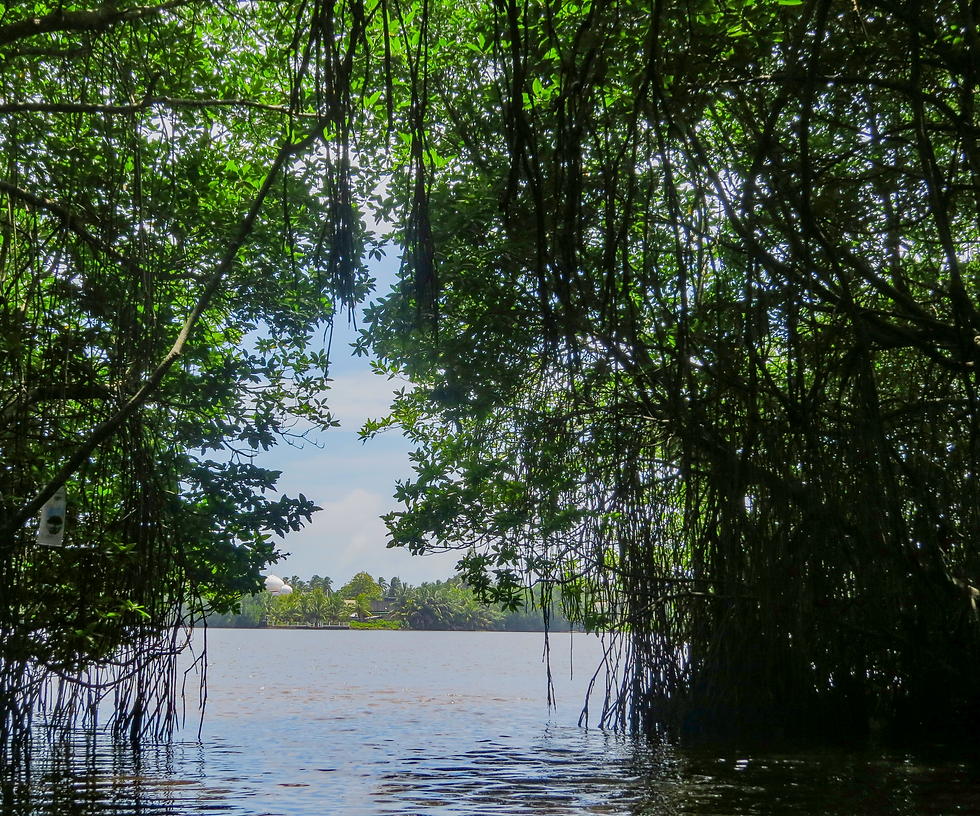
Growing where land meets the sea, mangroves are specially adapted to salty, waterlogged environments. Their tangled roots create miniature underwater worlds, their canopies provide shelter for wildlife, and their dense vegetation helps protect coastlines from erosion and extreme weather.
For travellers, a mangrove is more than somewhere to take a boat ride. It is an opportunity to experience one of Sri Lanka’s most fascinating coastal ecosystems while understanding why protecting it matters.
A Forest That Lives Between Two Worlds
Mangroves occupy a unique position between terrestrial and marine ecosystems. In Sri Lanka, they are generally found around lagoons, estuaries, river mouths and other sheltered coastal environments.

Their unusual appearance is part of what makes them so fascinating. Some species develop roots that rise above the mud, while others have elaborate networks of roots spreading through shallow water. These structures slow water movement, trap sediments and create shelter for countless organisms.
Sri Lanka has recorded more than 25 true mangrove species in different mangrove habitats, alongside numerous mangrove-associated plants. Species such as Rhizophora, Avicennia, Bruguiera and Sonneratia contribute to the diversity of these coastal forests.
Look closely and a mangrove is anything but quiet.
Fish move between the roots. Crabs disappear into the mud. Molluscs cling to submerged surfaces. Birds hunt along the water’s edge. Juvenile marine animals use the sheltered habitat as they grow.
What may initially appear to be a collection of trees is actually a highly productive ecosystem.

Why Should Travellers Care?
Mangroves may not have the immediate visual appeal of a leopard or an elephant, but their importance reaches far beyond their boundaries.
They protect the coast
Mangrove roots help bind and stabilise sediments, while the vegetation can reduce the force of waves and currents reaching the shoreline. This makes mangrove forests an important natural form of coastal protection.
Around the world, mangroves are recognised for their role in reducing the impacts of erosion, storms and other coastal hazards.
They support fisheries

Mangrove waterways and root systems provide nursery habitat and feeding grounds for fish, crustaceans and other aquatic organisms. This connects mangrove conservation directly to the livelihoods of many coastal communities.
For a traveller enjoying a seafood meal beside the coast, there is an often-unseen connection between that experience and the health of coastal ecosystems.
They store carbon
Mangrove ecosystems are important blue carbon habitats, storing carbon in both their vegetation and the sediments beneath them.
Protecting these forests therefore forms part of the wider response to climate change, while also protecting biodiversity and coastal communities.
They support biodiversity

Mangroves form a bridge between land and water. Their roots and waterways provide habitat for fish, crabs, molluscs and other aquatic species, while their branches and surrounding wetlands attract birds and other wildlife.
For nature lovers and photographers, this makes mangrove habitats particularly rewarding places to explore.
From Puttalam to the East: Mangroves Across the Island
Sri Lanka’s mangrove habitats are scattered around the island rather than forming one continuous forest.
Some of the country’s best-known mangrove landscapes are associated with lagoons and estuaries along the northwestern, northern, eastern and southern coasts.
Puttalam Lagoon has historically supported one of Sri Lanka’s most significant mangrove areas. The wider northwestern coastal region contains extensive lagoon, salt marsh and mangrove habitats.
The Kala Oya estuary has also been recognised for its extensive and relatively undisturbed mangrove ecosystems, while mangroves occur around several other lagoons and river systems around the island.
Further south, mangrove habitats can be explored around places such as Rekawa, while the eastern coast contains mangrove-fringed lagoons and estuaries associated with some of Sri Lanka’s important wetland landscapes.

This means that mangroves can become part of a very different kind of Sri Lankan journey – one centred not simply on sightseeing, but on discovering the connections between wetlands, wildlife, fishing communities and the ocean.
A Story of Loss and Recovery
Sri Lanka’s mangroves have faced considerable pressure over the years.
Conversion of coastal land, aquaculture, development, changes to water regimes and other human activities have contributed to the degradation and loss of mangrove habitats. Earlier assessments documented substantial declines in mangrove cover in several parts of the country.
But the story does not end with loss.
Sri Lanka has also become an example of how mangrove conservation can involve restoration, science and local communities working together.
The Sri Lanka Mangrove Regeneration Initiative, launched in 2015, has focused on restoring mangrove ecosystems rather than simply planting trees. According to FAO, the initiative had restored 500 hectares of mangroves and benefited 150 households at the time of its 2023 recognition as a UN World Restoration Flagship. Its longer-term programme targeted restoration of 10,000 hectares by 2030.
Sri Lanka also has a National Policy on Conservation and Sustainable Utilization of Mangrove Ecosystems, providing a national framework for conservation, restoration, research and sustainable use.
The lesson is important: restoring a mangrove is not simply a matter of putting seedlings into the ground. Healthy mangroves depend on the right tidal flows, sediment movement, salinity, hydrology and ecological conditions.
Sometimes, the best restoration is giving a damaged ecosystem the opportunity to recover naturally.
Mangroves as a Travel Experience
For visitors, mangrove ecosystems offer an opportunity to slow down.

A boat moving quietly through a lagoon can reveal a side of Sri Lanka that is very different from the country’s famous beaches and national parks. Instead of searching for one iconic animal, you begin noticing smaller details – the movement of a mudskipper, a kingfisher perched above the water, a crab disappearing beneath a root, or the reflection of mangrove branches in the lagoon.
Mangrove tourism can also provide an important connection between visitors and local communities.
Well-managed ecotourism can create economic incentives for keeping natural habitats intact. IUCN has highlighted mangroves’ potential for wildlife viewing and recreation, while Sri Lankan conservation policy has also recognised community-participatory ecotourism as one potential avenue for sustainable mangrove use.
But the experience should always be approached with care.
How to Explore Mangroves Responsibly
A mangrove may look resilient, but the ecosystem can be surprisingly sensitive.

When visiting a mangrove habitat:
Choose responsible local operators who respect wildlife and conservation guidelines.
Stay on established routes and avoid entering sensitive areas unnecessarily.
Do not touch, break or collect plants, shells, roots or wildlife.
Keep noise to a minimum, particularly around nesting and feeding birds.
Never leave plastic or other waste behind.
Avoid feeding wildlife.
Follow local regulations and protected-area requirements.
Support community-based tourism where possible, so that local communities benefit from protecting the ecosystem.
Ask questions. Learning from local guides can transform a simple boat trip into a meaningful conservation experience.
Most importantly, remember that you are a visitor in an ecosystem that supports wildlife and communities throughout the year.
Don’t Just Visit the Coast – Understand It!
Sri Lanka’s coastal landscapes are more than beaches.
Behind the familiar postcard image of turquoise water and palm-fringed shores are lagoons, mudflats, salt marshes, seagrass meadows and mangrove forests – all interconnected parts of the coastal environment.
Mangroves sit at the heart of that connection.
They protect shorelines, provide habitat, support fisheries, store carbon and connect terrestrial and marine ecosystems. Their survival is closely linked to the wellbeing of coastal communities and the health of the seas around Sri Lanka.

So the next time your journey takes you along the island’s coast, look beyond the beach.
Find the places where the water moves slowly between roots.
Listen for the birds.
Watch the mud for movement.
And remember that these seemingly quiet forests are working constantly to protect Sri Lanka’s shores.
Travel can be more than seeing a destination. It can be a way of understanding why that destination is worth protecting.


Comments